

When a major investment opportunity captures the attention of investors across Africa and beyond, it is worth taking a closer look. The Dangote Refinery IPO is one such opportunity, with its closing date extended to October 27, 2026, giving prospective subscribers additional time to assess the offer and complete their applications.
As interest grows, an important question emerges: Is the Dangote Refinery IPO a good investment? To answer this, investors need to look beyond the headlines and examine how the offer works, what it costs to participate, the potential opportunities and risks, and what it could mean for Africa’s capital markets.
Every major investment opportunity has its own rhythm. There is the excitement surrounding a new offer, conversations about potential returns and, sometimes, the fear of missing out when everyone seems to be paying attention. The Dangote Refinery IPO brings all these emotions into focus, placing one of Nigeria’s most significant industrial projects at the centre of investor conversations.
The offer comprises 4.1 billion ordinary shares priced at ₦525 per share, creating an opportunity for eligible investors to apply for an ownership stake in Dangote Petroleum Refinery and Petrochemicals FZE. Originally opened on September 14, 2026, the offer was scheduled to close on October 13 before its deadline was extended to October 27, 2026, following regulatory approval.
For investors across Nigeria and the wider African market, the extension presents an opportunity to look beyond the headlines and understand what the offer really means. How does the Dangote Refinery IPO work? How much does it cost to participate? How can eligible investors apply? And, perhaps most importantly, is it a good investment?
Before joining the excitement surrounding this major offer, investors need to understand the opportunity, evaluate the risks and determine whether it aligns with their financial goals.
The answers require more than enthusiasm. They require an understanding of the offer, the business, the risks and each investor’s financial objectives.
Latest on Dangote Refinery IPO: What Investors Need to Know
The latest reported development is the extension of the IPO application deadline to October 27, 2026, providing eligible investors with additional time to complete their applications.
The key reported offer details are:
- Company: Dangote Petroleum Refinery and Petrochemicals FZE
- Offer price: ₦525 per share
- Number of shares on offer: 4.1 billion ordinary shares
- Minimum subscription: 10 shares, equivalent to ₦5,250 before applicable charges
- Original closing date: October 13, 2026
- Revised closing date: October 27, 2026
Investors searching for the latest news on the Dangote Refinery IPO should confirm the offer’s current status, application instructions and any subsequent announcements through the issuer’s official communications, the approved prospectus and relevant regulatory notices.
An extension provides more time to assess an investment opportunity. It does not guarantee that an application will be successful or that the shares will increase in value.
Dangote Refinery IPO: How Does It Work?
An initial public offering, commonly called an IPO, is a process through which a company offers shares to investors under an approved offer structure.
In the case of the Dangote Refinery IPO, eligible investors can apply to subscribe for the ordinary shares described in the offer documents.
If shares are allotted to an applicant, that person acquires an ownership interest in the issuing company, subject to the rights attached to the shares.
The process generally involves the following steps:
- Review the offer: Read the approved prospectus to understand the company, the share offer, the risks and the terms.
- Confirm eligibility: Check whether you qualify to participate and whether any additional requirements apply.
- Complete registration and verification: Follow the approved process for account opening, identity verification and any required investor documentation.
- Submit an application: Use the officially designated subscription platform or authorised receiving agent.
- Follow the payment instructions: Pay only through the verified channels and according to the offer terms.
- Await allotment: The number of shares allocated may depend on the approved allocation process and the level of subscriptions received.
- Confirm your investment records: Follow the official instructions for verifying your allotment and shareholding records.
An IPO application is not the same as a confirmed purchase of the full number of shares requested. Applicants should consult the prospectus for details about allotment, refunds and the applicable timeline.
Dangote Refinery IPO: How Much Does It Cost?
One of the most common questions prospective investors ask is: How much is the Dangote Refinery IPO?
The reported offer price is ₦525 per share. The amount required therefore depends on the number of shares an investor applies for, excluding any applicable charges.
For illustration:
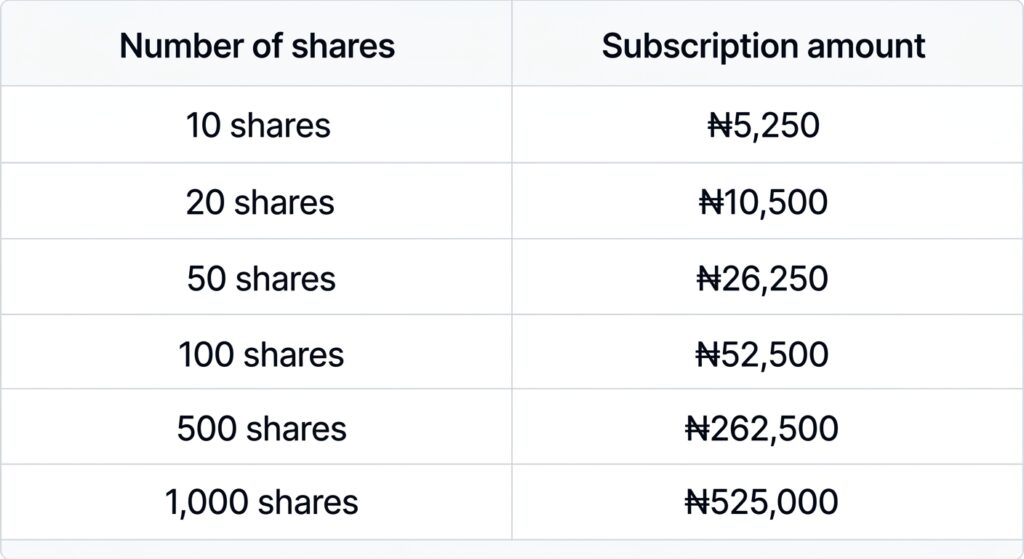
These figures are calculated using the reported offer price of ₦525 per share. They exclude applicable fees or charges and do not guarantee allotment.
How much is the Dangote Refinery IPO per share?
At the reported offer price, each share costs ₦525.
For example, an investor applying for 100 shares would need ₦52,500 before applicable charges. However, investors should confirm the minimum subscription, any permitted application increments and the current terms in the approved prospectus before applying.
Dangote Refinery IPO: How to Apply
Investors who want to know how to buy the Dangote Refinery IPO should begin by checking the official offer documentation rather than relying on instructions circulated through social media or unofficial investment groups.
The appropriate application process may vary according to an investor’s eligibility, location and the channels approved for the offer.
How to register for the Dangote Refinery IPO
Prospective investors should:
- Visit the issuer’s verified official website or the official offer page identified in the prospectus.
- Identify the approved subscription platform or authorised receiving agent.
- Complete the registration and identity verification requirements.
- Provide the required investor information and any applicable account details.
- Review the application carefully before submission.
- Retain the official confirmation and transaction records.
Investors outside Nigeria should also confirm whether they are eligible to participate and whether cross-border payment, identification or currency requirements apply.
How to subscribe to the Dangote Refinery IPO
To subscribe, follow the application and payment instructions contained in the approved offer documents.
Confirm the identity of the receiving agent, the payment destination, the offer deadline and any applicable charges before transferring funds. Do not pay an individual or an unofficial account based on a promise of guaranteed shares or guaranteed profit.
Because application channels and deadlines can change, investors should verify the latest instructions before taking action.
Dangote Refinery IPO: Is It a Good Investment?
The question “Is the Dangote Refinery IPO a good investment?” cannot be answered with a universal yes or no. Its suitability depends on the offer valuation, the company’s financial prospects, the risks involved and the investor’s individual circumstances.
The refinery’s scale and strategic importance may make it an attractive business to study. However, an important company is not automatically an attractively priced investment.
Investors should consider several factors before deciding.
1. The company’s business prospects
The refinery’s operations, production capacity, sales, operating costs and expansion plans can influence its future financial performance.
Investors should assess the company’s disclosed financial information and consider the commercial risks associated with refining, including crude oil availability, refining margins, energy costs, foreign exchange movements and regulatory changes.
2. The offer valuation
The offer price of ₦525 per share is a starting point for analysis, not proof that the shares are cheap or expensive.
Investors should review the financial information and valuation measures available in the prospectus, alongside the company’s capital requirements, liabilities and future business plans.
3. The potential for loss
Share prices can rise or fall. Investors may receive less than their original investment if they sell their shares at a loss.
There is also no guarantee that shares allotted through an IPO will immediately rise in market value or that investors will be able to sell at their preferred price.
4. The investor’s financial goals
Someone investing for long-term capital growth may have different requirements from someone who needs access to their money within a few months.
Investors should avoid committing money needed for essential expenses and consider how much exposure to a single company they can reasonably afford.
5. Portfolio diversification
Investing heavily in one company or industry can increase exposure to company-specific risks. Depending on their objectives and circumstances, investors may also assess other instruments, such as government securities, bonds and suitable investment funds.
Diversification cannot eliminate risk, but it can reduce dependence on one investment.
Ultimately, the Dangote Refinery IPO should be evaluated on its documented terms, financial prospects and risks—not simply on the company’s name or the excitement surrounding the offer.
How Could the Dangote Refinery IPO Affect Africa’s Capital Markets?
The potential significance of the Dangote Refinery IPO extends beyond the issuing company.
Large public offers can encourage conversations about equity ownership, investor education and the role of capital markets in financing African businesses.
If participation broadens across eligible local and regional investors, the offer could contribute to greater public engagement with equity investing. It may also help demonstrate the potential for African capital markets to mobilise domestic and regional savings for large-scale industrial activity.
However, the wider impact will depend on several factors, including the offer’s final outcome, investor participation, market infrastructure, disclosure standards and how the company performs after the offer.
The development also highlights several broader considerations.
More public awareness of investing: A prominent IPO can introduce more people to shares, prospectuses, risk assessment and portfolio planning.
Potentially broader investor participation: Well-designed and accessible subscription processes may help eligible investors participate in capital markets, subject to regulatory and operational requirements.
Greater focus on corporate disclosure: Large offers draw attention to the importance of transparent financial information, appropriate governance and clear communication with investors.
A conversation about African capital mobilisation: The offer provides an opportunity to discuss how regional capital markets can support businesses and infrastructure projects across the continent.
These are potential benefits, not guaranteed outcomes. A successful capital market requires more than one large IPO; it depends on investor confidence, sound regulation, reliable market infrastructure and consistent disclosure.
Beyond the IPO: Building a More Disciplined Investment Strategy
The biggest lesson from a major public offer may be the importance of having a strategy before the market becomes noisy.
Investors do not need to participate in every opportunity to make progress towards their financial goals. They need to understand what they are investing in, why they are investing and how the investment fits into their wider financial plans.
This is where professional asset management may be relevant.
Depending on an investor’s needs and the services available, a professional asset manager can help assess financial objectives, evaluate investment options, consider risk tolerance and monitor portfolio performance.
Professional management does not eliminate investment risk or guarantee returns. Its value lies in providing a structured approach to investment decisions and portfolio oversight.
Tro-Vest Asset Management offers investors an opportunity to explore professional investment management services and learn more about available investment options.
Rather than basing every decision on the latest market headline, investors can take a more deliberate approach to understanding their financial goals and the options available to them.
Visit Tro-Vest Asset Management to explore its services and obtain further information.
Understand the Investment Before Joining the Dance
The Dangote Refinery IPO has brought industrial investment, share ownership and African capital markets into the spotlight.
The extension of the offer deadline to October 27, 2026, provides eligible investors with additional time to review the offer and complete the required processes.
But the most important question is not whether everyone else is participating. It is whether the investment is suitable for your financial objectives and whether you understand its potential risks.
Read the prospectus. Verify the application process. Evaluate the company’s financial prospects. Consider diversification. Seek professional guidance when necessary.
When the market starts dancing, let your investment strategy lead.
Frequently Asked Questions About the Dangote Refinery IPO
1. What is the latest news on the Dangote Refinery IPO?
The latest reported development is an extension of the offer deadline from October 13 to October 27, 2026. Investors should verify the current status through the issuer’s official communications and approved offer documents before applying.
2. How much is the Dangote Refinery IPO?
The reported offer price is ₦525 per share. The minimum subscription is reported as 10 shares, equivalent to ₦5,250 before applicable charges. Confirm the current terms in the approved prospectus.
3. How does the Dangote Refinery IPO work?
Eligible investors submit applications for shares through approved subscription channels. Applications are processed according to the offer terms, and applicants may receive all, some or none of the shares requested, depending on the applicable allotment process.
4. How can I buy or subscribe to the Dangote Refinery IPO?
Review the approved prospectus, confirm your eligibility, complete any required registration and identity verification, and submit an application through the officially designated platform or authorised receiving agent.
5. Is the Dangote Refinery IPO a good investment?
Its suitability depends on the offer valuation, the company’s financial prospects, the investment risks and your financial objectives. The IPO does not guarantee profits, and investors should review the prospectus before making a decision.
6. How could the Dangote Refinery IPO affect Africa’s capital markets?
It could encourage investor education, broaden participation in equity investing and increase discussion about financing African businesses through capital markets. The actual impact will depend on investor participation, market infrastructure, regulation and the company’s subsequent performance.
Disclaimer: This article is for educational and informational purposes only. It is not an offer to sell securities, a solicitation to buy shares or personalised investment advice. Investments involve risk, including the possible loss of capital. Offer details and subscription instructions must be verified against the latest approved prospectus and regulatory notices. Investors should consult appropriately qualified professionals where necessary.